In this piece i used James' love for seascapes as the subject. He was so captured by South America's canals and waterways that after he visited there he made his famous series of "Nocturne" paintings consisting mostly of seascapes and water. The composition resides a lonely boat floating out beyond his city, which is in the backround, abandoning his home. While making this piece i tried to use the same process that Whistler did as he painted. I started with a red underpainting and gradually made shapes and tones with first browns, then adding blacks blues and some green, and finally putting some white and yellow to even out all the cool colors and also show the lights of the city. This process consisted of multiple layers and a great supply of 'sauce'. (sauce is what Whistler called these huge goops of paint and a lot of liquid mixed together so it's very drippy and messy)
Monday, November 23, 2009
Summer Days
Whistler’s emphasis was on his ordinary life and what he witnessed around him. He used subjects like relatives and friends as his subjects, and with them he used color to create a mood. In my piece I decided to, like Whistler, use subjects who meant something two me, so I have depicted a group of my close friends eating ice cream and talking, a very ordinary day in my life during the summer. I used brighter colors with a dull red paper to create a carefree mood, yet the overtone of the dull paper creates an ease to the scene. I also used multiple light sources to emulate the idea of the impressionists of the time, yet I maintained a realistic mark. This piece was done on colored paper in Prisma Colored pencils and Nupastels.
Realism verses Impressionism
It was the late nineteenth century that realism overtook British art that would influence Whistler. Subjects were no longer romanticized or classicized. The movement rejected the subjective and emotional characteristics of Romanticism. Instead, artists concentrated on contemporary reality, often times depicting Down-to-earth, everyday subjects like landscapes; ordinary, working-class people; observable, contemporary life. Subjects like mythology, history or religion were avoided. Artists of realism believed that every day activities or the mundane were worthy of art as it captured the true aspects of humanity and what was actually happening in the world.
But Whistler was not only influenced by the realism movement, but also the impressionists movement. The impressionists goal was to depict changes of light to manipulate the viewer. Impressionists still used the idea that the realism artists used of the subject matter of mundane everyday life. The movement evolved from realism with large visible brush strokes, spacious compositions, and emphasis on lighting. Whistler’s work is often time related to the impressionists though his actual goal was to use color to provoke a mood in the viewer as oppose to manipulating light.
"Impressionism." Encyclopædia Britannica. 2009. Encyclopædia Britannica Online. 23 Nov. 2009 <http://www.britannica.com/EBchecked/topic/284143/Impressionism>.
Campbell, Donna M. "Realism." Www.wus.edu. Donn M. Campbell, 9 Aug. 2008. Web. 11 Nov. 2009..
But Whistler was not only influenced by the realism movement, but also the impressionists movement. The impressionists goal was to depict changes of light to manipulate the viewer. Impressionists still used the idea that the realism artists used of the subject matter of mundane everyday life. The movement evolved from realism with large visible brush strokes, spacious compositions, and emphasis on lighting. Whistler’s work is often time related to the impressionists though his actual goal was to use color to provoke a mood in the viewer as oppose to manipulating light.
"Impressionism." Encyclopædia Britannica. 2009. Encyclopædia Britannica Online. 23 Nov. 2009 <http://www.britannica.com/EBchecked/topic/284143/Impressionism>.
Campbell, Donna M. "Realism." Www.wus.edu. Donn M. Campbell, 9 Aug. 2008. Web. 11 Nov. 2009.
James Abbott McNeill Whistler: A brief History
American Born, but a British based artist James Abbott McNeill Whistler is notable for using a combination of multiple influences of art movements, such as realism and impressionism yet still maintaining very much his own individual style. Whistler was born in Massachusetts, but found himself traveling to other countries early in life when he went to live with his sister in London after his father had died. He then studied in France where he was influenced by the realism movement that was capturing the art world. After studying in France he found himself back in Brittan which he would call his home until he died. There he was influenced by the Impressonists and they’re use of color to depict light. He took the idea of using color, instead of manipulating light, to manipulate the emotions of the viewer. Whistler experimented with landscapes and people but was best known for his portraiture's and his piece Whistler’s Mother.
Whistler's Mother James Abbott McNeill Whistler"James McNeill Whistler." Encyclopædia Britannica. 2009. Encyclopædia Britannica Online. 23 Nov. 2009 <http://www.britannica.com/EBchecked/topic/641961/James-McNeill-Whistler
Saturday, November 21, 2009
Later Works

In 1871 Whistler made his next big painting in which he is known for called Arrangement in Grey and Black: Portrait of the Painter's Mother. With this painting became tension between Whistler and the Academy and the episode turned so bad that he was pretty much banned from the Academy. During the 1870's Whistler made his greatly appreciated and magnificent Nocturne series. In the 70's Whistler took his love for Oriental art and detail to decoration and created Peacock Room and Fighting Peacocks for a London home. He then created Arrangement in Grey and Black No. 2: Portriat of Thomas Carlyle (1872) and Nocturne in Black and Gold: The Falling Rocket (1875). In 1877 a critic denounced Whistler and his piece The Falling Rocket and he sued the critic wining but in the end it ended up giving him a bad name and led to his bankruptcy in 1879. Whistler returned to England in 1880 were he messed with a variety of subjects and continued with an interest in the graphic arts creating Red and Black: The Fan and his last painting simply Brown and Gold.
Works Cited:
Holden, Donald. Whistler Landscapes and Seascapes. New York, New York: Watson-Guptill Publications, 1969.
Pioch, Nicolas. "Whistler, James Abbott McNeill". WebMuseum. BMW Foundation, 14 Oct. 2002. Web. 10 Nov. 2009. http://www.ibiblio.org/wm/paint/auth/whistler/
Early Works

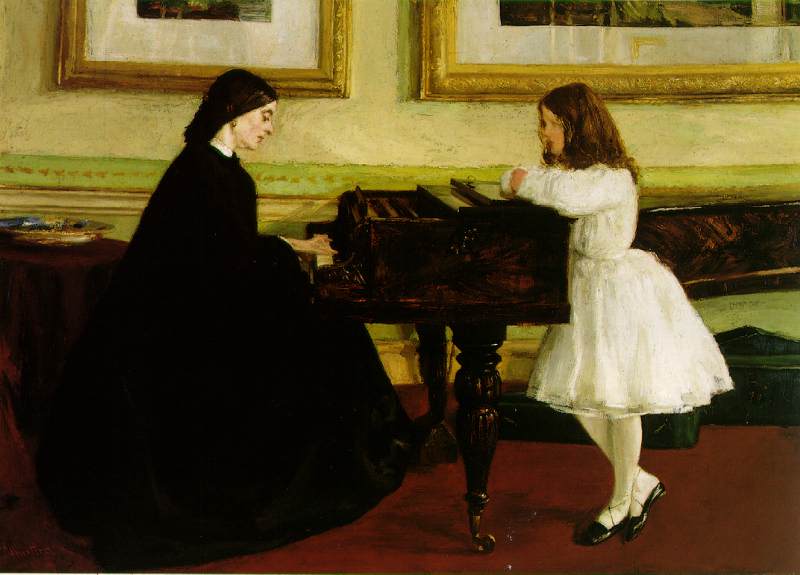
Through his friend, Whistler met Courbet whose realism inspired most of his early works including At the Piano which was first rejected by the Salon in 1859, but was well recieved at the Royal Academy in 1860. In this time Whistler began to make a name for himself and soon started a series of etchings in Paris where the revival of etchings with artistic creativity was begining to take place. This is were his obscure landscapes and humble figures first started to show up. Soon after his success with At the Piano he traveled to Amsterdam where he was deeply enthralled by the rivers and canals and recorded many canals and areas of water. In his next piece Symphony NO. 1, The White Girl as well as Symphony in White No. 1, The Little White Girl Wistler's fasination for Japanese art had started to show through elements in his work and was rejected at both the Salon and Royal Academy. His fasination for the east took his paintings even further with Purple and Rose: The Lange Leizen of the Six Marks. From 1861 to 1865 James Abbott Whistler's style evolved into a radically new vision of space. For example, The Coast of Brittany and The Beach at Selsey Bill depicts the same information and colors but the effect in The Beach at Selsey Bill is tipping the landscape up towards us with the beach turning into a massive flat plain of color. The figures also become notes of color instead of a sleeping fisher girl complete with a costume.With this sense of space Whistler began painting with the minimum number of pictorial elements and strokes to show his message. In 1866 Whistler ventured over to South America to paint seascapes. After returning back to Paris he began a series of great figure compositions called the Six Projects which was influenced by Albert Moore. He never really finished this commision but the wash and glazing techniques and attention to decorative designs were there to stay.
Works Sited:
Pioch, Nicolas. "Whistler, James Abbott McNeill". WebMuseum. BMW Foundation, 14Oct. 2002. Web. 10 Nov. 2009. http://www.ibilio.org/wm/paint/auth/whistler/
Holden, Donald. Whistler Landscapes and Seascapes. New York, New York: Watson-Guptill Publications, 1969.
Sutton, Denys. James McNeil Whistler. London, England: Phaidon Press LTD, 1966.
Wednesday, November 18, 2009
Yard Nocturne in Blue and Umber
James Abbott McNeill Whistler was a master of tone and color. Every color in his paintings was chosen to harmonize with one another, and resonate with the viewer. He titled some of his works as “nocturnes” or “arrangements”, comparing his harmonious works with those of classical compositions of music. In my piece, “Yard Nocturne in Blue and Umber”, I have painted in the style of Whistler. I have chosen colors that are earthy and harmonious, allowing the viewer to have an appealing visual experience. My art speaks for itself, as does Whistler’s. The subtle changes within the branches beckon to Whistlers changes of color.
In addition to a strong attention to color, Whistler also worked rapidly, producing works that were true to his surroundings. He often used washes and large brushstrokes to further the feeling of concordance within the piece. In my own piece I used a light blue wash to set the stage for a sky that was being consumed by the night. Contrasting his general washes, Whistler would usually include small accents of bright colors that would add visual interest to common spaces. I have implemented this into my work with the addition of small faint lights in the background house, and in the obvious light source in the upper left-hand corner. I enjoyed working tonally, and I think the piece was successful in creating a landscape that reminds viewers of Whistler’s nocturnes.
Subscribe to:
Posts (Atom)